Cold spark machines: the indoor fireworks your venue can actually approve
A cold spark machine burns a titanium alloy granule to throw a 1m to 5m fountain of white-gold spark on cue. It holds no explosive and no gunpowder, so no South Australian pyrotechnician licence applies to it. Venue approval is a separate question, and this page answers both.
What a cold spark machine actually is
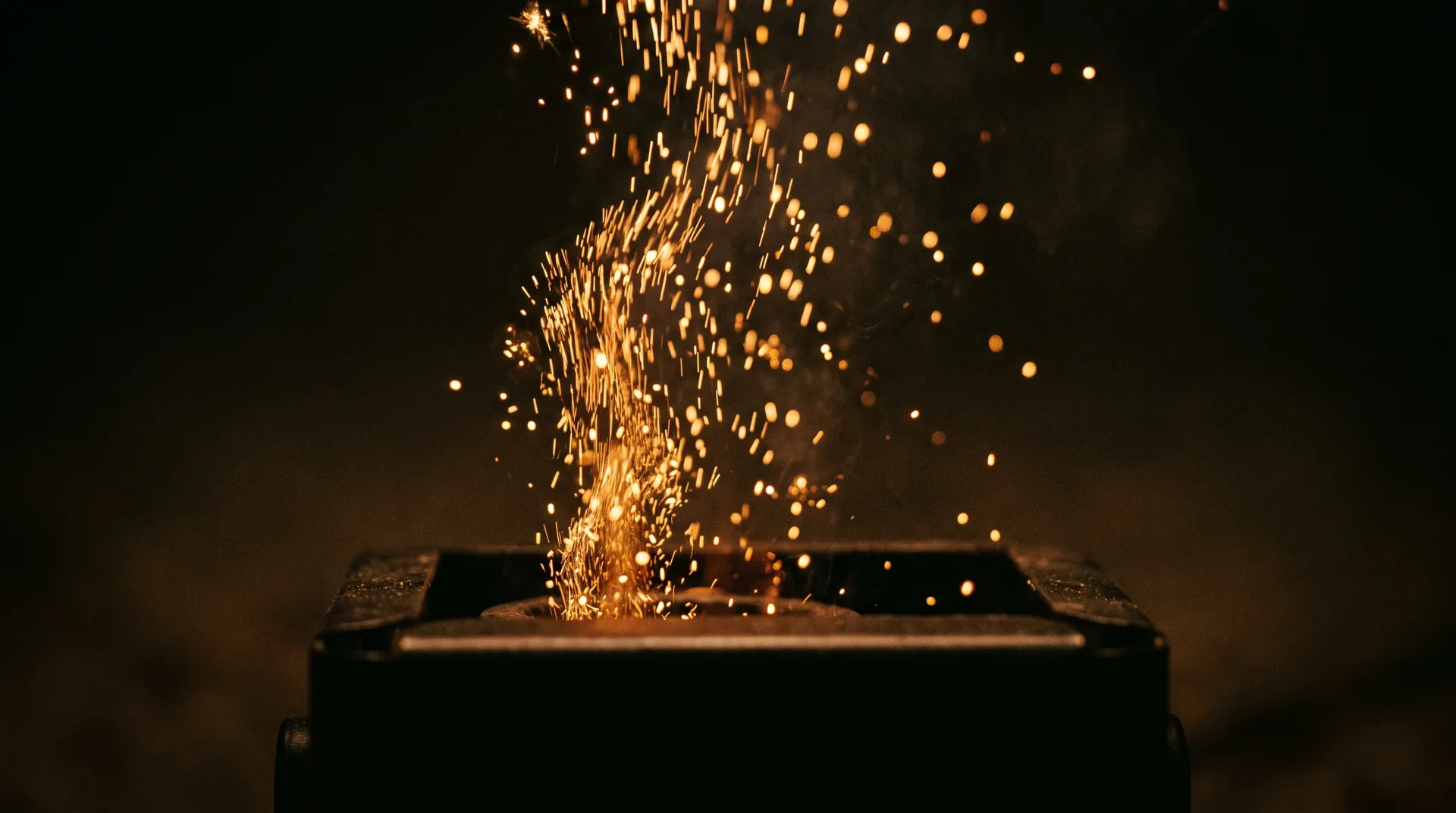
A cold spark machine is a floor-standing unit that heats a small charge of powdered titanium alloy and ejects it upward or at an angle through a nozzle. There is no flame at the point of discharge, no smoke and no combustion in the way a firework burns. What the camera sees is a dense fountain of white-gold particles, typically 1m to 5m tall depending on the machine and how much granule is loaded, running for anywhere from a couple of seconds up to about 20 seconds per firing. The effect reads best against a dimmed room, which is why every Adelaide operator asks the venue to kill the downlights for the moment rather than fight them.
The granule is the consumable. A machine needs reloading between firings, so a package covering the entrance, the first dance and the cake needs either 3 reloads on the same units or a bank of machines pre-loaded and staged, so nobody is crouched refilling a hopper while guests watch. Firing is triggered remotely, usually a wireless remote or a small DMX cue fired to the beat of the entrance track, which is why an operator times the cue rather than a guest with a phone.
Physically, each unit is roughly the size of a large shoebox to a small PA speaker, stood upright on a flat, stable surface. 2 units either side of a doorway read as a modest sparkle. 4 read as a proper arch, which is the spec most couples land on once they have seen both in photos. 6 to 8 lining an aisle is a production rather than a wedding add-on, and the packages and pricing page prices that jump honestly rather than folding it into a single number.
The licence position in South Australia
Cold spark machines are not fireworks and contain no explosive, so no South Australian pyrotechnician licence applies to them. Venue approval always does. That is the whole legal position, and it follows directly from the statutory definitions in the Explosives (Fireworks) Regulations 2016: a firework or pyrotechnic article is defined around an explosive or combustible composition, and a titanium granule that oxidises briefly in air contains neither.
Contrast that with what does need a licensed operator: indoor close-proximity pyro such as gerbs and fountains that burn an actual pyrotechnic composition, outdoor aerial displays, and flame machines. All 3 are referred to a licensed South Australian pyrotechnician rather than quietly folded into a cold spark booking, and the honest version of that referral is set out on the outdoor fireworks page.
Legal position stated as at 10 August 2026. South Australia's Explosives Act 1936 and the Explosives (Fireworks) Regulations 2016 are the operative law. The Explosives Act 2024 (SA) received assent on 19 September 2024 but had not commenced as at that date, and it will change licence names and fees when it does. Nothing here is legal advice: confirm your own position with SafeWork SA.
What your venue can and cannot say no to
Every readable South Australian venue policy bans things for 3 unrelated reasons: debris (confetti, glitter, rice), naked flame (candles, sparklers, gas cylinders) and smoke detection (dry ice, haze, smoke machines, often driven by the MFS false alarm call-out fee). A cold spark unit produces none of those 3 things. The full argument is on the venue guide.
Carrick Hill and The Pavilion publishes the most detailed ban in the state: confetti, bio-confetti and rice, open flame including sparklers and candles outdoors, smoke machines, dry ice machines, gas cylinders and explosive devices, plus a clause recovering the MFS false alarm call-out fee from the hirer. That reaches almost every other effect here. It does not reach cold spark, which is why the Carrick Hill policy page calls this the strongest case in South Australia for the effect.
Adelaide Town Hall runs the hardest ban published by any Adelaide venue: candles and naked flame, smoke, dry ice, haze, confetti and glitter. Cold spark is not named, but a ban this explicit is put to the venue in writing with a risk assessment before anything is confirmed, not assumed as a yes. See the Adelaide Town Hall policy page.
National Wine Centre of Australia bans confetti and rice and conditions sparkler exits, but cold spark, dry ice and CO2 are not mentioned at all, which is silence rather than permission. Most of the other 41 South Australian venues checked for this build publish no effects policy whatsoever, which is its own finding: the absence of a rule is a reason to ask in writing before the day, not a yes.
What cold spark actually costs in Adelaide
The ranges below are verified Adelaide market pricing as at 10 August 2026, gathered from published operator quotes. They are not a Wedding Sparks Adelaide price list; every booking is quoted individually once the venue and the moments are known.
| Package | Verified range | What moves the number |
|---|---|---|
| Cold spark, 2 machines, 1 moment | $400 to $690 | The entry point everywhere in Adelaide. The cheapest verified local quote was $400; the dearest at this spec was $690 quoted ex GST, which is why it looks higher again on the invoice. |
| Cold spark, 4 machines, 1 moment | $690 to $995 | 4 machines is the spec that reads as an arch rather than 2 lonely fountains, and it is where most couples land. |
| Cold spark across 3 moments | $900 to $1,190 | Entrance, first dance and cake. The operator stays for the night rather than firing once and leaving. |
| Cold spark plus dry ice first dance | $1,250 to $1,875 | The most-photographed combination at an Adelaide reception, and the top of the mainstream market. |
| Waterfall spark curtain | From $1,200 | Rigged above head height so the sparks fall. Only 2 Adelaide operators were found offering it, and rigging and venue fees sit on top. |
| Dry hire, per cold spark machine | $150 to $170 | Machine only, no operator, no insurance, no venue paperwork, and you carry the risk. Read the dry hire guide before you choose this. |
Watch the GST line. One Adelaide operator quotes its $690 package ex GST, while the rest quote inc GST, so 2 identical-looking numbers are not the same price once the invoice arrives. The cost guide flags that trap, and the dry hire guide covers what the $150 to $170 per-machine floor leaves out.
Clearances, ceiling height, power and setup
A fountain that reaches 3m to 5m needs at least that much genuine headroom plus a safety margin, which rules out a full arch in a function room with low beams, hanging florals or a chandelier at head height. A room under about 3m still works, but the fill is reduced to a shorter, tighter fountain rather than the tallest spec in a supplier's demo video. Each unit also needs a clear radius of roughly 2m to 3m around it, so ask the operator to check aisle spacing and guest seating against the floor plan before the day, not on it.
Power is a standard 10-amp outlet per machine. Multiple units on the one circuit in an older heritage building can trip a breaker mid-reception, which is why an operator brings dedicated power distribution rather than relying on the venue's existing points. Bump-in for a single-moment booking runs 15 to 30 minutes: positioning, cable runs and a test firing before doors open, done during the vendor access window rather than while guests are seated.
What actually goes wrong on the night is rarely the machine itself. It is a unit aimed a fraction too high and catching an overhanging drape, an outdoor booking caught by a gust it was not braced for, or a changeover timed too tightly so the reload for the cake moment is still happening when the MC calls it. A light dusting of spent granule does fall directly beneath each unit once it fires, so "zero mess" is not accurate. It is swept in minutes, but a heritage floor or an outdoor deck gets a drop sheet under the unit as a matter of course.
- Spark fountain height, depending on machine and fill
- 1m to 5m
- Clear radius required around each unit
- 2m to 3m
- Typical bump-in per moment before guests arrive
- 15 to 30 min
Where cold spark is not the right call
- Low ceilings and heritage fixtures. A room with beams, chandeliers or sprinkler heads at head height cannot safely host the tallest fountains, and reducing the fill to fit the room reduces the exact drama the reference photos promise.
- It is a moment, not a mood. Each firing lasts a few seconds to about 20 seconds. A couple picturing sparks running through an entire first dance is picturing something closer to a supplier's demo reel than what a realistic machine count and budget can sustain.
- Dry hire risk on the one shot that cannot be redone. A $150 to $170 machine-only hire removes the operator and the insurance, and a misfired cue at the grand entrance has no professional recourse. See the dry hire versus operated guide.
Questions couples actually ask
Answers stated as at 10 August 2026. If yours is not here, put it in the enquiry form and it gets a straight answer, not a brochure.
How close can a cold spark machine sit to a smoke detector?
Cold spark produces no smoke and no aerosol, so it does not trigger an optical smoke detector the way haze or a fog machine does. It still throws a genuine shower of hot granule, so operators keep units clear of a detector's immediate airspace as a matter of course, not because the detector reads it as smoke.
How many machines does a grand entrance actually need?
2 machines, one either side of the doorway, reads as a modest sparkle in photos. 4 machines is the spec most Adelaide couples land on because it reads as a full arch rather than 2 lonely fountains. 6 to 8 lining an aisle is a production, not a wedding add-on, and prices accordingly.
Can I dry hire a cold spark machine and fire it myself?
Yes. It is legal, and Adelaide operators publish a $150 to $170 per-machine dry hire rate. What that price does not include is an operator, public liability insurance, the venue paperwork most coordinators now ask for, or anyone to fix a misfire on the one moment that cannot be redone.
How far ahead should I book cold spark for a wedding?
As soon as the venue is locked in. Adelaide's operator pool is small and the October to November and March to April peaks book out first. Outside those windows, 2 to 4 weeks is usually workable.
What does the venue need to see before it says yes?
A certificate of currency, a written risk assessment for the specific effect, and a method statement covering placement, clearances and cleanup. Most coordinators will not approve a verbal description of the effect; they approve the paperwork.
You might also find this useful
- What your venue allowsThe 3 ban clusters explained, and why cold spark sits outside all of them.Read it
- Are cold sparks safe indoors?Written for the venue coordinator who has to approve it, not for the couple.Read it
- Dry hire versus operatedWhat the $150 machine-only rate does not include.Read it
- Dancing on a cloud (dry ice)The most-photographed pairing with cold spark, and why it is a separate booking decision.Read it
- Marry me signs and stylingThe staging and backdrop couples book alongside a cold spark entrance.Read it
- Packages and pricingEvery effect on one comparison table.Read it
- Carrick Hill effects policyThe venue with the hardest ban on everything except cold spark.Read it
Tell us your venue and the moments you want
Send the venue name and the moments you want, and we'll pass your enquiry to a local operator. Ask them for a written read of the venue's actual policy and a real number inc GST.
- We read your venue's actual published conditions, not a guess.
- Pricing comes back inc GST and itemised by moment.
- Surprises stay surprises: tick the discreet box and replies carry no identifying subject line.