Are indoor fireworks safe? How cold spark machines actually work
This page is written for the person who has to approve the effect, not the couple who wants it. What the granule is, what it does at distance, and which manufacturer lines we will not repeat.
Keep reading
A venue coordinator asked to approve “indoor fireworks” is right to be cautious, because the phrase is doing a lot of misleading work. Almost every indoor effect couples show a coordinator on their phone is a cold spark machine, not a firework. It contains no gunpowder, no explosive charge and no pyrotechnic composition, so it is a different category of equipment to the thing the word “fireworks” describes, and the approval question is really about heat, clearance and detection, not about explosives.
What the spark actually is
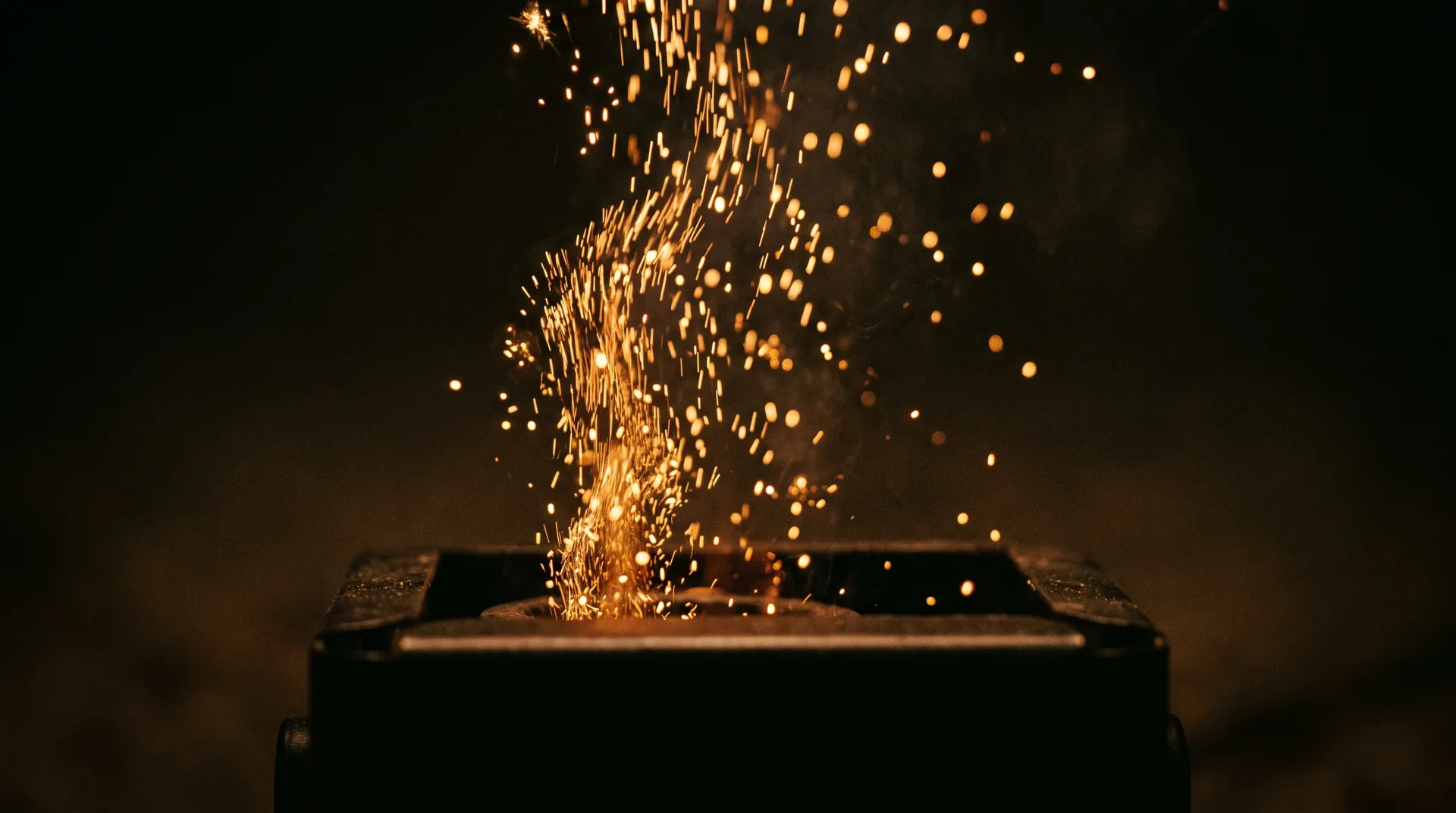
Inside the unit, a small quantity of titanium alloy granule sits above a heating element. When the operator fires a cue, the granule is heated past its ignition point and mechanically ejected upward, where it burns as it travels, throwing a fountain of bright, short-lived sparks roughly 1m to 5m high depending on how the unit is set and loaded. There is no combustion chamber, no propellant charge and no chemical oxidiser mix of the kind used in an aerial shell or a ground firework. The granule itself is the entire fuel source, and it is consumed within the height it is set to throw.
That distinction is why the effect sits outside South Australia’s fireworks licensing regime rather than inside it: the statutory definitions are built around explosive and pyrotechnic composition, and a heated metal granule has neither. It is still an ignition source, which is why it is operated by a trained person and why every job still needs the venue’s own sign-off. That combination, no explosive but a real ignition source, is the whole safety conversation in one sentence.
Real clearances and headroom
A cold spark particle sheds most of its heat as it burns during flight, which is why the effect reads as safe on nearby fabric at a normal working distance and is the reason venues that ban candles and naked flame outright will still consider this effect on its merits. That is a description of how the particle behaves, not a guarantee for every fabric at every distance, and it is not treated as one. Every reputable operator sets the unit’s throw height and duration to suit the room, keeps a clear working radius free of guests, drapery and low-hanging decorations around each unit, and never points a unit at a person, a soft furnishing or a doorway. Because clearance scales with the throw height chosen for that specific room, it is a room-by-room decision made on site, not a single number that applies everywhere, and a coordinator is entitled to ask for the specific clearance plan before the day rather than a generic assurance.
Why an optical smoke detector does not trigger on it
Cold spark produces no smoke and no aerosol, so it does not register on a photoelectric or optical smoke detector the way a haze machine or a glycol-based smoke machine does. This is the single most useful fact for a coordinator weighing a request against a venue’s fire safety system, because it means the effect does not carry the false-alarm risk that drives most venue bans on fog and haze in the first place. Dry ice low fog sits in a related but separate category: it sinks and rolls along the floor rather than rising, which is why it also tends to stay below a ceiling-mounted detector, though it is still a visible fog and some venues choose to treat it more cautiously than cold spark for exactly that reason. A unit positioned close to a heat detector, rather than a smoke detector, is a different question again, and clearance from any detector head is kept regardless of type.
Power is a standard mains outlet on every unit used for these bookings. Larger multi-machine setups or a waterfall spark curtain are cued together from a single control point rather than fired by hand at each unit, which is what makes a synchronised entrance or first dance moment repeatable on cue.
What a proper risk assessment and method statement contain
A coordinator approving an effect for the first time is really approving a set of documents, not a machine. The paperwork a venue should expect before the day:
- Certificate of currency confirming public liability cover, current on the date of the event.
- A written risk assessment naming the specific hazards for that room: cable runs, the floor area beneath each unit’s throw path, proximity to guests and to soft furnishings, and the control measure for each one.
- A method statement describing the setup sequence, who fires the cue, how many units are used, and the pack-down process once the moment has fired.
- A named point of contact on the day, so the coordinator has someone to raise a concern with in real time rather than after the booking is confirmed.
Read the venue guide for how this paperwork lines up against the actual clauses in 12 published South Australian venue policies, and what to send a coordinator who has never seen a request like this before.
Legal position stated as at 10 August 2026. South Australia's Explosives Act 1936 and the Explosives (Fireworks) Regulations 2016 are the operative law. The Explosives Act 2024 (SA) received assent on 19 September 2024 but had not commenced as at that date, and it will change licence names and fees when it does. Nothing here is legal advice: confirm your own position with SafeWork SA.
Claims worth distrusting, including from us
The industry markets this effect using a handful of lines that do not survive scrutiny. They are worth naming so a coordinator can spot them anywhere they appear, not only on this site.
- “Recognised by Worksafe as non-pyrotechnic.” There is no Australian regulatory body called Worksafe that certifies products as non-pyrotechnic. The phrase sounds official and means nothing.
- “100 percent safe.” No ignition source is absolutely safe. This is a marketing absolute, not a technical claim, and it is not one this site makes.
- “Non-flammable.” The unit generates burning particles by design. Calling the effect non-flammable misdescribes the mechanism it relies on.
- “Cool to touch” and “fire-alarm friendly.” Both are manufacturer lines repeated as fact without qualification. A particle that has just finished burning is not something a guest should be encouraged to touch, and “fire-alarm friendly” overstates a specific, narrower claim about optical smoke detectors into a general guarantee it cannot support.
The defensible version of all 4 claims is shorter and less exciting: cold spark machines are not fireworks and contain no explosive, so no South Australian pyrotechnician licence applies to them. Venue approval always does, and it is decided venue by venue, on the actual paperwork, not on a manufacturer’s marketing copy.
Questions couples actually ask
Answers stated as at 10 August 2026. If yours is not here, put it in the enquiry form and it gets a straight answer, not a brochure.
Is a cold spark machine classified as a firework in South Australia?
No. It contains no explosive and no pyrotechnic composition, which places it outside the Explosives Act 1936 (SA) and the Explosives (Fireworks) Regulations 2016 that govern licensed fireworks. Venue approval is a separate question from the law and is decided by the venue, not by the classification.
Can a cold spark machine set off a venue's smoke alarm?
It produces no smoke, so it does not trigger an optical or photoelectric smoke detector, which is the type almost every reception venue uses. Haze machines, glycol smoke machines and some fog effects are the ones that trigger this class of detector, and that is why they are the ones named in most venue terms.
Is cold spark hot enough to burn a guest or ignite fabric?
The particles shed most of their heat during the burn, which is why the effect is used at close working distances in a room. That is a description of behaviour, not a guarantee, which is why clearance from guests and soft furnishings should be set for every booking rather than assumed.
Does the operator need a pyrotechnician licence to run a cold spark machine?
No licence applies under South Australian law, because the unit is not classified as a firework or an explosive device. That is a legal statement, not a safety one: the effect is still run by a trained operator and still needs the venue's own approval.
What should a coordinator ask for before approving the effect?
A certificate of currency, a written risk assessment naming the room's specific hazards, a method statement describing setup and pack-down, and a named operator contact for the day. If any of those 4 items is missing, that is the question to ask before the booking is confirmed, not after.
You might also find this useful
- What your venue allowsThe 3-cluster reasoning behind every South Australian venue ban, and 12 real published policies.Read it
- Effects and SA lawThe full licence table, the operative legislation, and the 4 industry claims that do not hold up.Read it
- Safety and insuranceThe certificate of currency and per-effect risk assessment, ready to send to a venue.Read it
- For venues and plannersThe B2B version of this page, written for the events team approving the booking.Read it
- Dancing on a cloud (dry ice)How dry ice low fog behaves differently to cold spark, and why it sinks instead of rising.Read it
Send us the venue and ask for the paperwork
We'll pass your enquiry to a local operator. Ask them for a certificate of currency, a written risk assessment and a method statement, addressed to your coordinator before the day, not on it.
- We read your venue's actual published conditions, not a guess.
- Pricing comes back inc GST and itemised by moment.
- Surprises stay surprises: tick the discreet box and replies carry no identifying subject line.